
On World Health Day, a New Frame for Sickle Cell Disease in Africa
World Health Day Perspective from RHIEOS
The World EPA Congress in Amsterdam in March 2026 brought one point into sharp focus for me: access to health technologies will become more contested.
New therapies are emerging. But access is now shaped by much more than whether a product exists. It is shaped by who can generate evidence, who can define value, who can build payment pathways, who can secure manufacturing and supply, and which populations are treated as central to serious planning rather than left at the margins.
That shift matters profoundly for sickle cell disease.
What stood out to me in Amsterdam was the gap between the breadth and nuance of global access conversation and the narrow frame still often applied to high-burden sickle cell populations in Africa. When the discussion turns to how new models of access might work in these settings, the response still too often drifts toward philanthropy, humanitarian exception, or academic interest, rather than toward serious long-term system design. That frame is no longer good enough.
SCD is still too often framed as rare, neglected, or as a specialist condition. In Africa, it is none of those things. It is a major public health challenge.
The scale alone should force a rethink. Africa CDC said in 2025 that 45 children are born with sickle cell disease in Africa every hour. That is more than 1,000 births a day. WHO has also reported that 50–80% of infants in Africa born with SCD die before age five, where early diagnosis and basic care are limited. And globally, WHO estimates that sickle-cell disease contributed to 81,100 under-five deaths in 2021, making it the 12th leading cause of death in that age group when the full mortality burden is counted.
They point to a challenge that sits much closer to child survival, primary care, blood systems, maternal risk, and long-term health-system capacity than to the narrow category in which SCD is still often placed.
For that reason, RHIEOS believes SCD should be understood differently.
It should be seen not only as a disease burden, but as a practical starting point for building stronger systems of care.
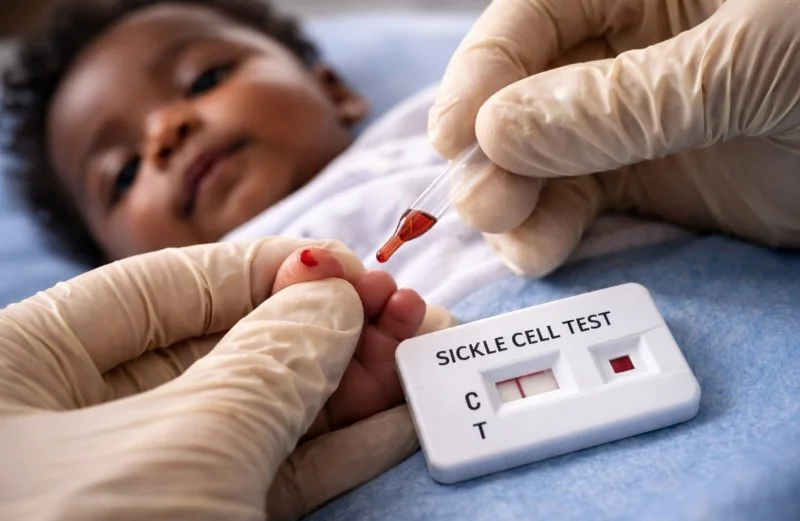
That means beginning with what matters most now: earlier diagnosis, stronger newborn screening, more reliable access to hydroxyurea and other essential treatment, better blood services, better referral pathways, stronger patient records and registries, and more consistent long-term care. These are immediate needs for people living with SCD. They are also the same building blocks that strengthen care more broadly across blood health, chronic disease, maternal care, surgery, and other areas where health systems are already under strain.
If SCD is seen only as a neglected burden, the likely response is piecemeal: fragmented programs, short-term efforts, and work that never fully escapes the margins. If it is seen instead as an anchor condition for stronger blood-health and chronic-care systems, a different possibility emerges. The question shifts from how to manage one difficult disease to how to use one clear and urgent challenge to build shared capacity with wider public value.
That broader view matters even more now because the politics of access are changing. Access is shaped not only by scientific progress but also by delivery capacity, evidence systems, financing arrangements, supply security, and institutional confidence. In that environment, high-burden populations cannot remain outside serious planning. If Africa continues to be treated only as the site of highest need, rather than as a place where stronger systems can be built, the result will be more of the same: late access, fragile delivery, and continuing dependence on exceptional rather than durable solutions.
RHIEOS is putting forward a different view.
We see sickle cell disease as a credible entry point for a broader blood-health and chronic-care platform: one that starts with practical priorities, builds shared infrastructure over time, and strengthens readiness for the future. It is a call to connect immediate patient needs with stronger systems in a more coherent and durable way.
This work is still at an early stage. We are opening a conversation. We are putting a frame into the public domain because we believe it deserves serious attention: that one of the continent’s clearest and most consequential health challenges can also become a starting point for stronger, fairer, and more future-ready systems of care.
In the coming period, RHIEOS will continue engaging a small number of stakeholders across healthcare, patient advocacy, philanthropy, policy, and industry to test and refine this proposition. The aim is not simply to describe the problem more clearly, but to help shape a more practical response.
If this perspective resonates with your work, we welcome thoughtful engagement.
Selected sources: WHO sickle-cell disease fact sheet (2025); Africa CDC, A New Day for Children with Sickle Cell Disease (2025); WHO AFRO SICKLE Package and related guidance (2024)