
Investing in Access: Financing Sickle Cell Care in Africa
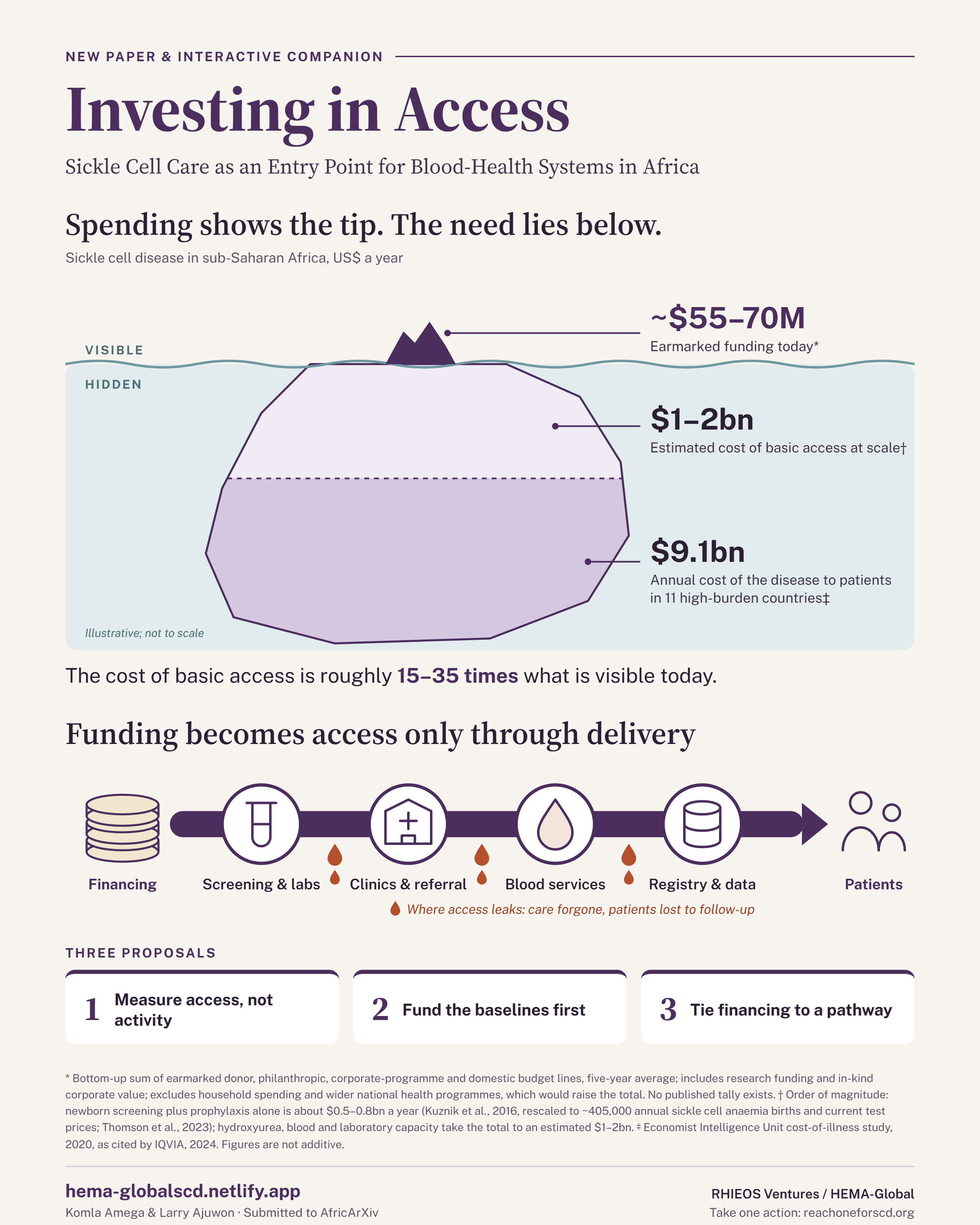
The central investment problem in sickle cell disease (SCD), and in blood health more broadly, is the lack of a coordinated way to finance access. Because SCD spans blood health, chronic care, and maternal and child health, that gap weakens far more than a single disease programme.
Where public investment and coverage are limited or absent, families bear most of the cost of care. Need that is paid for privately, deferred or forgone leaves little trace in expenditure data, so budgets capture only part of the demand and miss the need that most requires a response.
Financing access therefore needs to begin with a different evidence base. Investing in Access: Sickle Cell Care as an Entry Point for Blood-Health Systems in Africa, by Komla Amega and Larry Ajuwon, proposes access intelligence: the integration of registry, service, patient, cost and capacity data. Together, these locate where care breaks down, identify the capability that is missing, and match each gap to an appropriate form of financing.
Financing mechanisms determine where money comes from but do not decide where investments need to go. The paper rejects a single, fixed sequence for strengthening systems. In some settings, foundational capacity must come first; in others, a targeted intervention can generate momentum for broader reform. The question for policymakers and investors is what is missing, what would close the gap, and how it should be financed.
The paper makes three proposals, each of which any government, funder, patient organisation or diaspora partner can take up independently:
Adopt access measures with published baselines: diagnosis before the first birthday, completion of scheduled follow-up, and uninterrupted access to hydroxyurea.
Fund those baselines as a costed first-phase deliverable in at least one high-burden country, so later investment can be judged against them.
Match financing mechanisms to a pathway, so that diaspora and pooled funds are tied to a defined clinical pathway and a registry able to report against it.
This is why SCD is an entry point. Investment in access to SCD care builds the screening, laboratory, blood-service, referral, and data capacity on which wider blood-health systems depend.
Read the paper and explore the interactive companion: https://hema-globalscd.netlify.app
Submitted to AfricArXiv; preprint forthcoming.
Take one action: https://reachoneforscd.org