
Part 2 - Zero-Redline Thinking: How to Build Resilient Contracts That Win Clinical Trials
The Contracts Manager rose to circulate what looked like one-page flyers he had been guarding closely throughout the meeting. Legal counsel gave him a quizzical look.
He explained that the document was a short-form Clinical Trial Agreement (CTA)—written in plain language, distilled from the company’s standard template and previously executed contracts.
“Is it understandable, flexible, balanced, and usable?” he asked. “Does it cover the essentials—scope, risk, payment, and data rights?”
Legal responded first: the form didn’t comply with company policy, and most sites would never agree to it.
The manager smiled.
“That’s exactly the point,” he said. “If contracts were designed this way—so clear and balanced that no one felt compelled to redline them—we’d eliminate months of negotiation. A CTA now takes three to four months to finalize; an amendment can take an additional one to two months.”
He paused.
“We’re dissatisfied with the quality of our agreements and collaborations—across CROs, labs, technical services, and partnerships. These failures compound.
“Imagine if a design-for-trust template, backed by coherent policies, guidelines, and playbooks, could remove all that pain.”
Silence settled in the room.
Eleanor sensed that the Zero-Redline idea had landed. It was, in essence, a proposal to redesign the contract itself—not as a legal weapon, but as a tool for trust and collaboration.
Why Contracts Fail
Weeks passed after the pre-mortem, and turning insight into an agreed plan proved harder than expected. Approval across departments stalled. The issue eventually reached the executive level, since it implied revisiting corporate policy.
The Contracts Manager’s radical one-page CTA was set aside, but his questions had opened a door.
Teams combed through legacy and active contracts, analyzing negotiation logs and outcomes to trace the roots of failure.
Painful stories surfaced.
In one study, site activation was delayed for weeks—patients waited—because parties couldn’t agree on the indemnification cap. In another, disputes erupted over whether the budget covered unscheduled patient visits.
Patterns emerged.
Key contributors included:
- Disconnect between policy and practice: gaps between stated values and operational reality embedded in SOPs, playbooks, and templates.
- Misaligned priorities: sponsors, sites, and CROs entering negotiations with divergent incentives and expectations
- Imbalanced standard terms: boilerplate clauses perceived as one-sided, prolonging negotiation cycles.
- Lack of clarity in key elements: objectives, scope, logistics, and payment terms left vague or inconsistently applied.
- Inefficient review cycles: repeated drafting rounds eroding trust, momentum, and morale.
- Non-standard handling of sensitive clauses: intellectual property, data ownership, publication rights, and indemnification diverging from accepted norms.
- Overly rigid templates and legalistic language: dense structures discouraging comprehension and systemic problem-solving.
- Poorly aligned incentives: contractual goals failing to reinforce collaboration or shared success.
The conclusion was uncomfortable but unmistakable: the system itself was failing.
Turning Foresight into Action
The pre-mortem revealed that most breakdowns clustered into three systemic categories:
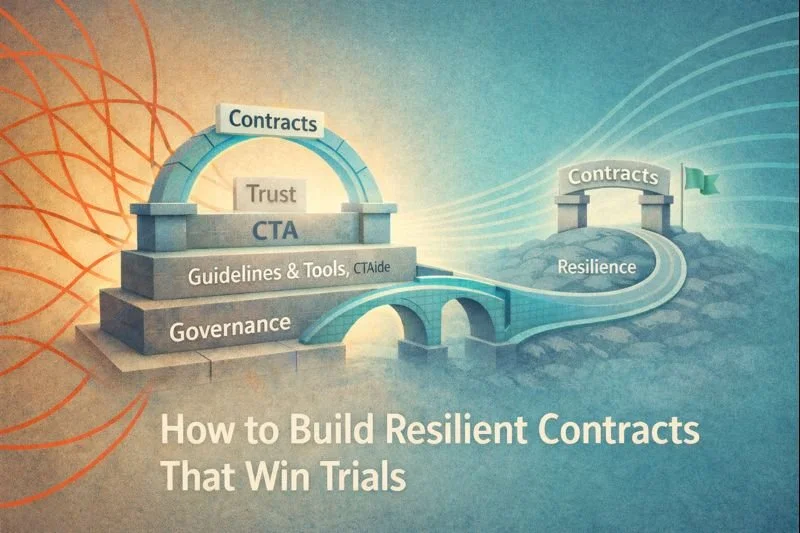
- Governance — policies and contractual frameworks
- Guidelines and Tools — playbooks, negotiation processes, review practices
- Goals and Roles — clarity of objectives, accountability, and performance measures
Contracting could not be fixed in fragments. It required integrated redesign—a cultural and procedural recalibration.
They began with governance. Policies were aligned with ISO 9001 (quality management) and ISO 44001 (collaborative business relationships), establishing a shared language for consistency, transparency, and trust.
Next came tools.
Templates and playbooks were rewritten with a single mandate: make them usable.
The goal was not to simplify the law, but to make legal structure intelligible to those executing it. Each clause carried plain-language guidance explaining intent and risk.
A Contract Review Checklist helped identify red flags early. But to create visibility across studies, they formalized this knowledge into a Clinical Trial Agreement Inventory and assessment tool (CTAide, its digital companion)
Clinical Trial Agreement Inventory provided a structured reference for developing or reviewing CTAs. It maps essential elements—scope, risk, governance, payment, data—and highlights common negotiation pitfalls. It helps reviewers see what is covered, what is missing, and what requires escalation**.
CTAide analyzes agreements for completeness, balance, and usability—flagging clauses that are one-sided or ambiguous. It quantifies risk exposure and visualizes balance across sponsor, CRO, and institution.
Together, these tools turned the Zero-Redline aspiration into something tangible: a trust instrument that could evolve with each negotiation.
In effect, CTAide became a translation layer between human intention and institutional memory—encoding fairness, balance, and precedent into the contracting system itself.
Finally, the focus turned to people.
Policies and tools were necessary, but capability was the multiplier.
Eleanor championed cross-functional training sessions simulating negotiations under real time pressure. The exercises built fluency, empathy, and systems thinking—qualities no software could automate.
“We’re not just contracting faster,” she told the team. “We’re contracting smarter.”
Contracts as the Capstone of Collaboration
Weeks later, Eleanor paused by the watercooler before another program meeting.
A milestone echoed in her mind: forty-five days to site activation; contracts signed on the final day.
The weight was real—and not hers alone.
Even with everything in place, trials could falter.
Yet every failure left traces: a shard of insight into disease progression, a clue to biology’s hidden logic, a refinement of what would not work.
Each study contributed a piece to the Alzheimer’s puzzle.
The contract, she realized, was more than a legal checkpoint. It was both signal and artifact—evidence that trust had been forged and alignment reached.
Like a capstone set atop an arch, it completed a structure that, though fragile, pointed forward.
Beneath that arch lay not just the promise of one therapy, but the shared pursuit of cures yet to come.
She took her glass of water, smiled at the doodle in her notebook—a timeline knocked over by a redline—and felt, for once, that the team had built something resilient enough not merely to endure reality, but to shape it—to give their science its best chance to succeed.
Acknowledgment
CTAide ™ was developed by RHIEOS Ventures in collaboration with Engage Clinical Contract Solutions.
Clinical Trial Agreement Inventory ™ is developed and owned by Engage Clinical Contract Solutions.
Further Reading
Methods and Decision Science
Klein, G. (2007). Performing a Project Premortem. Harvard Business Review. https://hbr.org/2007/09/performing-a-project-premortem
Cognitive Bias Lab. Premortem Template and Resources. https://www.cognitivebiaslab.com
Clinical Trial Contracting Tools and Frameworks
Clinical Trial Agreement Inventory and CTAide. https://www.ctaide.com
Dealligence. Collaboration and Negotiation Framework.
Engage Clinical Contract Solutions. Twelve Clinical Trial Contracting Lessons.
Hagan, H. et al. The Contract Design Pattern Library: A Repository of Visually Enhanced, Modular Contract Formats.
Clinical Trial Operations and Start-Up Delays
Getz, K. et al. (2020). Drivers of Start-Up Delays in Global Randomized Clinical Trials. Contemporary Clinical Trials. https://pmc.ncbi.nlm.nih.gov/articles/PMC7505220/
Miller, J. et al. (2023). Critical Path Activities in Clinical Trial Setup and Conduct: How to Avoid Bottlenecks and Accelerate Clinical Trials. Contemporary Clinical Trials. https://www.sciencedirect.com/science/article/abs/pii/S1359644623002490
Relational and Collaborative Contracting
Frydlinger, D., Vitasek, K., Bergman, J., & Cummins, T. (2019). Contracting in the New Economy: Using Relational Contracts to Boost Trust and Collaboration in Strategic Business.
Frydlinger, D., Hart, O., & Vitasek, K. (2019). A New Approach to Contracts. Harvard Business Review. https://hbr.org/2019/09/a-new-approach-to-contracts